Showing posts with label History. Show all posts

Monday, October 14, 2019

Some hitherto unkown genealogical trees of music


In last week's post, I discussed Petter Hellström's recent doctoral thesis: Trees of Knowledge: Science and the Shape of Genealogy. In this thesis he discusses three "genealogical tees" in detail. Augustin Augier’s tree of plant families and Félix Gallet’s family tree of languages have already been covered in this blog (you can look them up using the Search box, to the right), but Henri Montan Berton’s family tree of chords has not.

Indeed, the historical literature at large has pretty much ignored the idea of a genealogical tree being associated with music. Nevertheless, the tree itself is explicitly labeled a Genealogical Tree of Chords. This tree, and its predecessor by François Guillaume Vial, thus deserve examination.


Henri Montan Berton (1767–1844) is well known within the history of music; and his tree was published as an independent broadsheet as two (almost identical) editions in c. 1807 and 1815. It seems to have been produced as a teaching tool, as indeed were also the trees of Augier and Gallet. As Petter Hellström notes, for these authors "genealogy did not necessarily involve chronology or change ... the introduction of family trees into secular knowledge production had more to do with the needs of information management, visualisation and communication".

Berton himself states (translated from the French):
In composing the Genealogical Tree, one has has had the intention to present to the eye, at a single glance, the reunion of the great family of Chords, and to demonstrate to the eye that there is only one Primordial [Chord], and that it is the source of all Harmonies.
At the base of the tree is a fundamental bass note along with its 12th and 17th major — this was the harmonic series in 18th century music theory. From here the tree produces 8 branches above, each labeled (at the bottom) with a musical chord, and with another 20 chords labeled further up the branches (all highlighted by arrows at the left). The main trunk (denoted A) is labeled Perfect or Constant Chord. The eight branches are intended to show the relationships between "8 fundamental chords [bottom arrow] and 20 inverted chords [the upper arrows]".

The tree thus displays the harmonic relationships among the chords, rather than any sort of chronological development. It was devised as an aid to learning the fundamentals of music composition.

Berton was not the first to use this idea within music theory. Four decades earlier, in 1766, François Guillaume Vial (1725–?) had produced another broadsheet, this time labeled Genealogical Tree of Harmony.


Like Berton's tree, this is not about chronology, but is about "family relationships" in a different sense. Moreover, in this instance the branching aspect of the tree is abandoned, and the tree foliage is simply festooned with medallions, labeled with chords — it is the different sections of the tree's crown that show relationships, not different branches.

The objective here was to illustrate "the most natural order of harmonic modulation", once again devised as a teaching tool. The two compass roses at the bottom left and right show the circle of fifths (left), guiding horizontal modulation among the chords, and the circle of thirds (right), guiding vertical modulation among the chords.

Vial himself states (translated from the French):
This Genealogical Tree simplifies and allows those who are capable of intonation [to practice] the art of preluding not only on a leading note, but even to change between the most desired modulations of any instrument.
Hellström traces these uses of the "family tree" metaphor in music back to Jean-Philippe Rameau (1683–1764), an influential music theorist. Thus, he concludes that we should:
read the trees of Vial and Berton as graphical codifications of an already established metaphor and manner of thinking about harmony, especially as both authors were informed by Rameau in their understanding of harmony in the first place.
In constructing their respective tree diagrams, Berton and Vial both seized upon an already existing metaphor and made it visible on paper. Their trees are not 'genealogical' in the sense that they charted family history or cross-generational relationships, they are 'genealogical' in the sense that they depict presumably natural, organic relationships, in which every part has its place in the whole, and where every part can be referred back to a common source or root.
These trees do not, therefore, fit into the usual history of genealogical trees, as this blog recognizes them, denoting a chronological history. They, would, however, fir neatly into the post on Relationship trees drawn like real trees.

Monday, October 7, 2019

A recent thesis about Trees of Knowledge


Recently, Petter Hellström successfully defended his doctoral thesis:
Trees of Knowledge: Science and the Shape of Genealogy
Department of the History of Science and Ideas
Uppsala University, Sweden
The thesis itself is obviously of great interest to readers of this blog. It is not currently online, but you can obtain a printed or electronic copy by contacting:


Here is the abstract:
This study investigates early employments of family trees in the modern sciences, in order to historicise their iconic status and now established uses, notably in evolutionary biology and linguistics. Moving beyond disciplinary accounts to consider the wider cultural background, it examines how early uses within the sciences transformed family trees as a format of visual representation, as well as the meanings invested in them.
Historical writing about trees in the modern sciences is heavily tilted towards evolutionary biology, especially the iconic diagrams associated with Darwinism. Trees of Knowledge shifts the focus to France in the wake of the Revolution, when family trees were first put to use in a number of disparate academic fields. Through three case studies drawn from across the disciplines, it investigates the simultaneous appearance of trees in natural history, language studies, and music theory. Augustin Augier’s tree of plant families, Félix Gallet’s family tree of dead and living languages, and Henri Montan Berton’s family tree of chords served diverse ends, yet all exploited the familiar shape of genealogy.
While outlining how genealogical trees once constituted a more general resource in scholarly knowledge production — employed primarily as pedagogical tools — this study argues that family trees entered the modern sciences independently of the evolutionary theories they were later made to illustrate. The trees from post-revolutionary France occasionally charted development over time, yet more often they served to visualise organic hierarchy and perfect order. In bringing this neglected history to light, Trees of Knowledge provides not only a rich account of the rise of tree thinking in the modern sciences, but also a pragmatic methodology for approaching the dynamic interplay of metaphor, visual representation, and knowledge production in the history of science.
The trees of Augier and Gallet have been covered in this blog, but that of Berton has not. I will discuss it in the next post.

Monday, September 23, 2019

Where are we, 60 years after Hennig?


Phylogenetic analysis is common in the modern study of evolutionary biology, and yet it often seems to be a poorly understood tool. Indeed, it seems to often be seen as nothing more than a tool, and one for which one does not need much expertise.


For example, we do not need to spend much time on Twitter to realize that many evolutionary biologists do not understand even the most basic things about the difference between taxa and characters. Taxa are often referred to as "primitive", particularly by people studying the so-called Origin of Life. However, taxa themselves cannot be either primitive or derived; instead, they are composed of mixtures of primitive and derived characters — they have derived characters relative to their ancestors and primitive ones compared to their descendants.

The logical relationship between common ancestors and monophyletic / paraphyletic groups is also apparently unknown to many evolutionary biologists. There is endless debate about whether the Last Universal Common Ancestor was a Bacterium or an Archaean when, of course, it cannot be either. That is, we sample contemporary organisms for analysis, which come from particular taxonomic groupings, and from these data we infer hypothetical ancestors. However, those ancestors cannot be part of the same taxonomic group as their descendants unless that taxonomic group is monophyletic.

This is all basic stuff, first expounded in the 1950s by Willi Hennig. So, why do so many people apparently still not know any of this 60 years later? I suspect that somewhere along the line the molecular geneticists got the idea that Hennig was part of Parsimony Analysis, and since they adopted Likelihood Analysis, instead, he is thus irrelevant.

However, Hennigian Logic underlies all phylogenetic analyses, of whatever mathematical ilk. All such analyses are based on the search for unique shared derived characters, which is the only basis on which we can objectively produce a rooted phylogenetic tree or network.

In the molecular world, many analysis techniques are based on analyzing the similarity of the taxa. However, similarity is only relevant if it is based on shared derived characters — if it is based on shared primitive characters then it cannot reliably detect phylogenetic history. This was Hennig's basic insight, and it is as true today as it was 60 years ago.

The confusing thing here is that most similarity among taxa will be based on both primitive and derived characters. This means that some of the analysis output reflects phylogenetic history and some does not. The further we go back in evolutionary time, the more likely it is that similarity reflects shared primitive characters rather than shared derived characters. This simple limitation seems to be poorly understood by evolutionary biologists.

Perhaps it would be a good idea if university courses in molecular evolutionary biology actually taught phylogenetics as a topic of its own, rather than as an incidental tool for studying evolution. After all, there is more to getting a scientific answer than feeding data into a computer program.

Obviously, I may be wrong in painting my picture with such a broad brush. If so, then it must be that the people I have described seem to have gathered on Twitter, like birds of a feather.

And yet, I see the same thing in the literature, as well. Consider this recent paper:
A polyploid admixed origin of beer yeasts derived from European and Asian wine populations. Justin C. Fay, Ping Liu, Giang T. Ong, Maitreya J. Dunham, Gareth A. Cromie, Eric W. Jeffery, Catherine L. Ludlow, Aimée M. Dudley. 2019. PLoS Biology 17(3): e3000147.
This seems to be quite an interesting study of a reticulate evolutionary history involving budding yeasts, from which the authors conclude that:
The four beer populations are most closely related to the Europe/wine population. However, the admixture graph also showed strong support for two episodes of gene flow into the beer lineages resulting in 40% to 42% admixture with the Asia/sake population.

However, they then undo all of their good work with this sentence:
The inferred admixture graph grouped the four beer populations together, with the lager and two ale populations being derived from the lineage leading to the Beer/baking population.
Nonsense! Neither lineage derives from the other, but instead they both derive from a common ancestor. This is like saying that I derive from the lineage leading to my younger brother, when in fact we both derive from the same parents. I doubt that the authors believe the latter idea, so why do they apparently believe the former?

That is a little test that you can all use when writing about phylogenetics. If your words don't make sense for a family history, then they don't make sense for phylogenetics either.

Monday, June 3, 2019

A phylogenetic network outside science


I have written before about the presentation of historical information using the pictorial representation of a phylogeny (eg. Phylogenetic networks outside science; Another phylogenetic network outside science). These diagrams are often representations of the evolutionary history of human artifacts, and so a phylogeny is quite appropriate. They are of interest because:
  • they are usually hybridization networks, rather than divergent trees, because the artifact ideas involve horizontal transfer (ideas added) and recombination (ideas replaced);
  • they are often not time consistent, because ideas can leap forward in time, so that the reticulations do not connect contemporary artifacts (see Time inconsistency in evolutionary networks); and
  • they are sometimes drawn badly, in the sense that the diagram does not reflect the history in a consistent way.
The latter point often involves poor indication of the time direction (see Direction is important when showing history), or involves subdividing the network into a set of linearized trees.

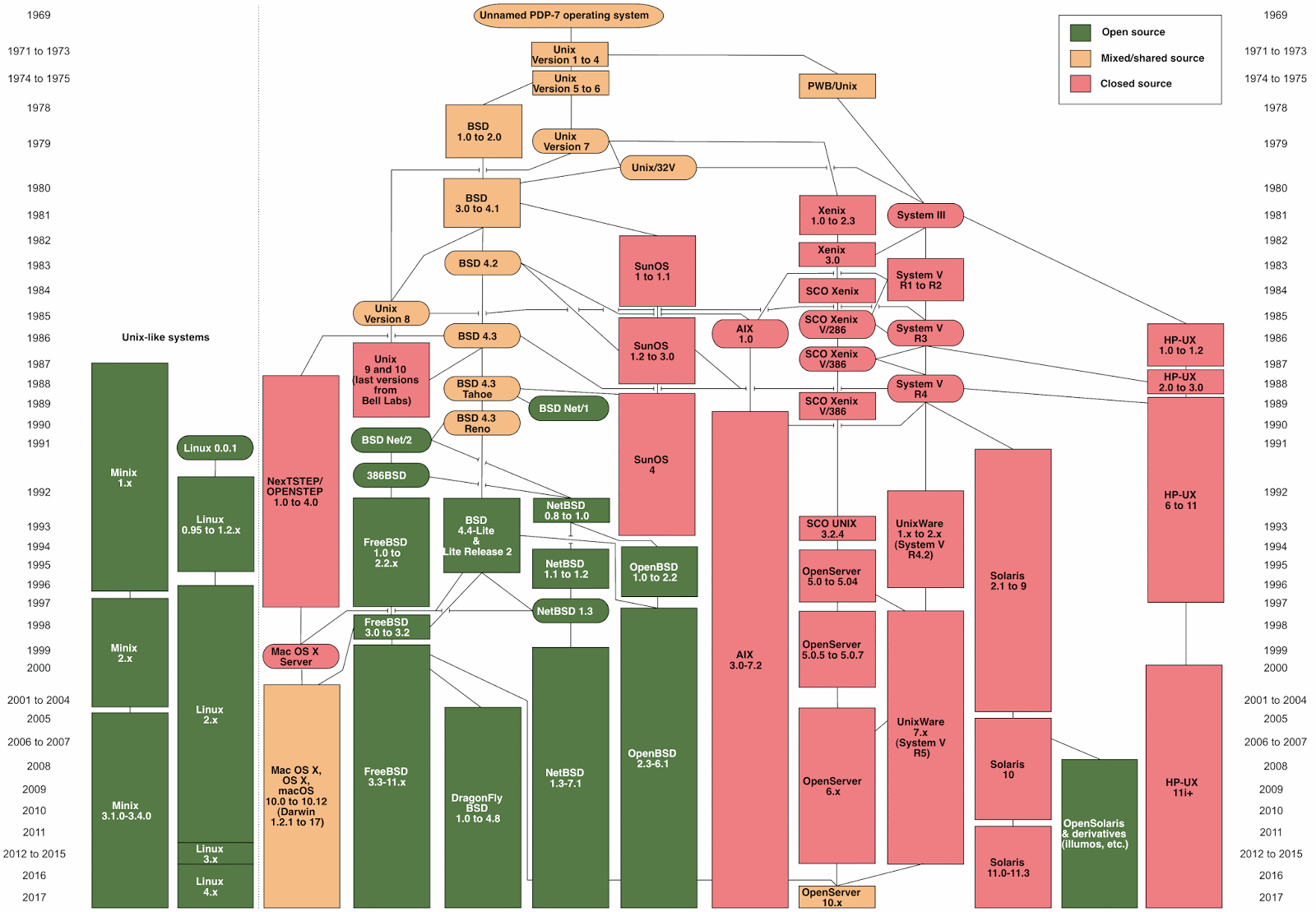
One particularly noteworthy example that I have previously discussed is of the GNU/Linux Distribution Timeline, which illustrates the complex history of the computer operating system. The problems with this diagram as a phylogeny are discussed in the blog post section History of Linux distributions.

In this new post I will simply point out that there is a more acceptable diagram, showing the key Unix and Unix-like operating systems. I have reproduced a copy of it below.

Click to enlarge.

This version of the information correctly shows the history as a network, not a series of linearized trees (each with a central axis). It also draws the reticulations in an informative manner, rather than having them be merely artistic fancies.

It is good to know that phylogenetic diagrams can be drawn well, even outside biology and linguistics.

Monday, May 6, 2019

Corals — a new metaphor for phylogenetic diagrams


A year ago I mentioned a published discussion of the different branching diagrams that have been used for phylogenetic relationships (Tree metaphors and mathematical trees). If we consider the form of the relationship and whether time is involved, we get the following four possible diagram types:


Most current phylogenetic diagrams claim to show sister-group relationships (which means that ancestors are inferred only), with a time-order to the branching sequence. There is a broad range of diagram types in use, both mathematical and metaphorical. For example, the top four in this next diagram are mathematical and the bottom four are metaphorical variants of the above 2x2 table:


The connection between these different diagrams has both conceptual and practical problems, although these seem to be overlooked by most practitioners. This issue as been addressed by János Podani in a paper that is now online:
The Coral of Life. Evolutionary Biology (2019).
To quote from the Abstract:
The Tree of Life (ToL) has been of central importance in the biological sciences, usually understood as a model or a metaphor, and portrayed in various graphical forms to summarize the history of life as a single diagram. If it is seen as a mathematical construct — a rooted graph theoretical tree or, as more recently viewed, a directed network, the Network of Life (NoL) — then its proper visualization is not feasible, for both epistemological and technical reasons. As an overview included in this study demonstrates, published ToLs and NoLs are extremely diverse in appearance and content ... Metaphorical trees are even less useful for the purpose, because ramification is the only property of botanical trees that may be interpreted in an evolutionary or phylogenetic context. This paper argues that corals, as suggested by Darwin in his early notebooks, are superior to trees as metaphors, and may also be used as mathematical models. A coral diagram is useful for portraying past and present life because it is suitable: (1) to illustrate bifurcations and anastomoses, (2) to depict species richness of taxa proportionately, (3) to show chronology, extinct taxa and major evolutionary innovations, (4) to express taxonomic continuity, (5) to expand particulars due to its self-similarity, and (6) to accommodate a genealogy-based, rank-free classification.
It is worth checking out this paper, even if only for the new Coral of Life diagram that is presented in its Figure 3, which synthesizes much of our current knowledge.

Monday, May 21, 2018

Misunderstandings and misrepresentations about Linné's alleged family motto


This is a joint post by Magnus Lidén and David Morrison

The Swedish biologist Carl Linnaeus (1707-1778) is well known in biology as the father of modern taxonomic nomenclature, although he is better known in his own country for writing a series of travel books that cataloged the cultures and resources of Sweden.* He was knighted in 1757, and took the noble name Carl von Linné, as well as adopting a coat of arms (shown below).

It is often claimed that at the same time he adopted a family motto:
Deus creavit, Linnaeus disposuit [Latin]
God created, Linnaeus organized [English]
Gud skapade, Linné ordnade [Swedish]
Gott erschuf, Linné ordnete [German]
This claim is repeated around the internet, almost always attributing the words directly to the man himself: Deus creavit, Linnaeus disposuit he liked to say (Smithsonian Institution); Deus creavit, Linnaeus disposuit he took as his motto (Harvard University); Deus creavit, Linnaeus disposuit was how Linnaeus himself summed up his lifetime achievements (Uppsala University; and Svenska Linnésällskapet — the Swedish Linnaean Society).

The motto has been used both to mock him for his presumptuousness and to praise him for his piety. Primary references for this alleged motto are, however, conspicuously absent from any of the web sites, and our search of the literature, as well as consultation with Linné experts, have failed to present any evidence that he ever used this motto himself.

In the standard Linné biography of Fries (1903), it is simply referred to as an "illuminating epigram which admiring contemporaries used" (see Jackson 1923), which does not explain how it came to be attributed to Linnaeus, nor where it come from. FV Hope (Anon. 1843) suspected it had originated as an act of malice. Although it has been used to that end by his adversaries, it was originally meant to express awe and admiration.

As far as we can determine, the first English-language use of the motto appears as the frontispiece of this book:
The Life of Sir Charles Linnæus, Knight of the Swedish Order of the Polar Star, &c, &c.
to which is Added a Copious List of His Works, and a Biographical Sketch of the Life of His Son

By D.H. Stoever, Ph.D.
Translated from the original German
By Joseph Trapp, A.M.
1794
B. and J. White, Fleet Street, London


As you can see, the motto is used as a banner situated directly below the coat of arms of Linné, and to all appearances is a part of it, with a portrait in profile above. This gives the impression that the words were coined by Linné himself (as was the case for the coat of arms).

However, the original German-language version of the book reveals a very different situation:
Leben des Ritters Carl von Linné
Nebst den biographischen Merkwürdigkeiten seines Sohnes, des Professors Carl von Linné
und einem vollständigen Verzeichnisse seiner Schriften, deren Ausgaben, Übersetzungen, Auszüge und Commentare

von Dietrich Heinrich Stöver, Doctor der Philosophie
1792
Benj. Gottl. Hoffmann, Hamburg


The frontispiece has the alleged motto flanking the coat of arms of Linnaeus, rather than being part of it. This makes all the difference to the interpretation. The portrait, incidentally, is a poor copper engraving, drawn from a plaster medallion by Inländer from 1773 (cf. Tullberg 1907).

Stöver reveals his source for the words in his 1792 preface:
Das Motto unter dem Bildnisse Linné's [...] wird hoffentlich mit der Religiosität keines Lesers in Collision kommen. Es rührt von einem Manne her, der ein langer Freund des Vestorbnen war.
However, in the 1794 English translation, "langer Freund" is embellished to the point of confusion:
The motto beneath the portrait of Linnaeus [...] will not, it is humbly presumed, offend the religious opinions of any reader. It originates with a man who has lived many years in the closest ties of intimacy with the deceased.**
Whoever devised it, it seems probable that this phrase is a post-Linnéan laudation communicated to Stöver orally or by letter. At any rate, it do not appear in print until 14 years after Linné's death.

This may seem like a rather harmless "factoid", but it highlights how easily erroneous beliefs can be established, even in a scientific environment.

Other myths

This brings us to a second myth, a misconstruction of the very core of Linné's views on classification, which has seriously distorted how the development of 18th century systematics is perceived. The widely held picture of Linné as an Aristotelian Essentialist, classifying nature by Medieval Scholastic Principles of Logical Division, dates from the work of Cain (1958; see Winsor 2006), and was uncritically accepted by several influential authors, such as Mayr (1982) and Futuyma (1998). But this is like stating that Darwin was a creationist!

On the contrary, the scholastic approach is strongly criticized by Linné. He was the first to clarify the conceptual difference between the top-down divisionis leges (which he claimed will by necessity result in artificial groupings and disruption of natural taxa) and synthetic systematization. Linné emphasized that natural taxa are not defined by characters but must be built from the basic entities (species) upwards (Linnaeus 1737). He was far ahead of his time in doing this. The misrepresentation of Linné's views by Cain's and his followers has been thoroughly debunked by, for example, Skvortsov (2002), Winsor (2006), Müller-Wille (2013) and others, but it seems to be hard to eradicate.

A more amusing misunderstanding is the so-called flower clock, reputedly planted by Linné in the Hortus Academicus of Uppsala (now called Linnéträdgården, The Linné garden), about which numerous visitors and journalists ask each year. However, Linné's flower clock (1751) was a list of selected phenological observations, which never materialized in the Uppsala academic garden as an actual plantation, nor was it ever meant to. Attempts to plant flower clocks in gardens have shown that they are not very accurate as to general time-keeping across seasons and latitudes.

Note:
It seems to be quite common in English to insist on the use of titles for British people but not for foreigners. As noted by Stöver and Trapp in their book, "Carl von Linné" is best treated as the Swedish equivalent of "Sir Carl Linnaeus".

References

Anon. (1843) Summary of a lecture by F. V. Hope – on the portraits of Linnaeus – read for the Linnean society 21 Feb 1843 (E. Forster, Esq. in the chair). The Athenæum (Journal of english and Foreign Literature, Science and the Fine Arts) 801: 218. [in vol. 1 for the year 1843, installments 783 to 817]

Cain AJ (1958) Logic and memory in Linnaeus' system of taxonomy. Proceedings of the Linnean Society of London 169: 144-163.

Fries TM (1903) Linné. Lefnadsteckning, 2 vols. Stockholm.

Futuyma DJ (1998) Evolutionary Biology, 3 edn. Sinauer Associates, Sunderland MA.

Jackson BD (1923) Linnaeus. Abridged and adapted from Fries 1903. London.

Linnaeus C (1737) Genera Plantarum. Conrad Wishoff, Leiden.

Linnaeus C (1751) Philosophia Botanica. Godofr. Kiesewetter, Stockholm.

Mayr E (1982) The Growth of Biological Thought. Harvard University Press, Cambridge MA.

Müller-Wille S (2013) Systems and how Linnaeus looked at them in retrospect. Annals of Science 70: 305-317.

Skvortsov AK (2002) Systematics on the threshold of the 21st century: traditional principles and basics from the contemporary viewpoint. Zhurnal Obshchei Biologii 63: 82-93. [In Russian; abridged translation by Irina Kadis on WWW]

Tullberg T (1907) Linnéporträtt. Aktiebolaget Ljus, Stockholm.

Winsor MP (2006) Linnaeus' biology was not essentialist. Annals of the Missouri Botanical Garden 93: 2-7.


* On May 18 we had Linnés trädgårdsfest, which is Uppsala's celebration of Linné's working life in the town.

**According to Guido Grimm, a more literal translation would be: "It originates from an old friend of the deceased, who, being of rare noble character, summarized the widely accepted opinion(s) of experts".

Monday, February 12, 2018

Tree metaphors and mathematical trees


We have had quite a few blog posts about the early metaphors used for genealogical (and other) relationships, whether they be for biology, linguistics or stemmatology. These early metaphors tended to be about trees, either in a literal sense or as a stick diagram of some sort, although we have tried to cover all of the early genealogical networks, as well.

One of Haeckel's oaks

However, this situation does create some potential confusion, because the concept of a genealogical (or phylogentic) tree in the modern world is very much based on the mathematical concept of a tree, which is a graph-theoretical construction. This was clearly not the intention of most of the early authors, especially those writing before Arthur Cayley introduced the mathematical concept (in 1857).

The mathematical version of a tree is a line graph, in which nodes are connected by edges. The edges must be directed if the graph is to represent evolutionary history (ie. the edges point away from the root); and it must be acyclic (or else a descendant could be its own ancestor). The leaf nodes are usually (observed) contemporary taxa, and the internal nodes are (inferred) ancestors. Note that this definition can be applied to both bifurcating trees and to reticulating networks.

This construction is valuable for computational purposes, because we can construct a mathematically optimal tree, which biologists can then use as a starting point for representing the hypothesized genealogy. However, it is not necessarily valuable as a metaphor, which was the purpose of most of the early authors.

There is thus a potential difficulty for modern reads to interpret the older diagrams; and it seems likely, in turn, that the authors of many of the older diagrams would be somewhat befuddled by the modern mathematical restrictions. Sometimes the metaphor and the mathematics will agree, and sometimes they won't.

Branching silhouettes

This issue has been addressed by János Podani in two complementary papers:
  • Tree thinking, time and topology: comments on the interpretation of tree diagrams in evolutionary / phylogenetic systematics. Cladistics 29: 315-327 (2013).
  • Different from trees, more than metaphors: branching silhouettes — corals, cacti, and the oaks. Systematic Biology 66: 737-753 (2017).
He calls the tree metaphors "branching silhouettes", to distinguish them from the mathematical trees. His basic point is this:
There has long been ambiguity in the use of the term tree in phylogenetic systematics, which is a continuous source of misinterpretation of evolutionary relationships. The basic problem is that while many trees with phylogenetic or evolutionary relevance ... are consistent with graph theory, tree-like visualization of phylogeny may also be done via other types of graphics, especially botanical (or literal) tree drawings. As a consequence, the meaning of such diagrams is not always clear: a given picture may have multiple interpretations in its different parts, and two figures that look similar may actually carry quite different information.
Podani resolves the ambiguity by recognizing two fundamental characteristics that any tree diagram will contain: (1) it may show either ancestor-descendant relationships or sister-group relationships; and (2) a time order may be important or it may be disregarded. This leads to a 2x2 representation illustrating the four basic types of "trees" that have been used in phylogenetics.

Podani's tree-metaphor classification

He gives the four types of branching silhouettes tongue-twisting, but appropriate, names.

The diachronous diagrams are "classic" evolutionary trees with a time dimension, which thus have ancestors as internal nodes and contemporary organisms as the leaves. The achronous diagrams are similar, but they allow descendants to arise from contemporary taxa — they are thus the classic "grade" trees showing morphological advancement, which thus allow paraphyletic ancestral groups. The synchronous diagrams are the modern cladograms, with no observed ancestors (but maybe inferred ones at the internal nodes). The asynchronous diagrams are similar, but they can have ancestors as leaves (eg. "pattern" cladograms of ancestors and descendants together).

Podani also gives these four branching silhouettes colloquial names. Charles Darwin is often credited with the tree metaphor, but in the Origin of Species he explicitly acknowledges predecessors, although he does not actually name them (see Naudin, Wallace and Darwin — the tree idea). In his own notebooks, his first metaphor is actually a coral (see Charles Darwin's unpublished tree sketches), and this is the name that Podani recommends for the classic evolutionary trees.

He names the grade trees as cactus, named after the common epithet for the diagram used by Charles Bessey (in 1915) to illustrate plant relationships (see the image below). Furthermore, he recommends oak for the two variants of cladograms, as this is a common epithet for some of the diagrams drawn by Ernst Haeckel (see Who published the first phylogenetic tree?, plus the diagram at the top of this post).

Bessey's cactus

Finally, Podani's work does raise an interesting question. Modern (cladistic) methods of phylogenetics are designed to work with synchronous trees (ie. no observed ancestors). To what extent do these methods work if you try to put fossils into the dataset, which are potential ancestors? After all, this would make the result an asynchronous tree, instead of a synchronous one.

Tuesday, July 11, 2017

The curious case of the word “stemma” — from circles to trees


Each word has its own history, according to a maxim attributed to Jules Gilliéron that makes some historical linguists tremble. One with a curious history is the word stemma (plural stemmata), which we stumble upon when investigating the development of phylogenetic trees.

David has been exploring this question for some time, showing how the origin ultimately lies in the alternative to the hierarchical model of the Aristotelian "scale" offered by the practice (and the metaphors) of genealogies and pedigrees. While dealing with possible influences on 19th-century biology, I have explored a different field, stemmatics ("textual criticism"), which shares with genealogical practices both the tree model and, obviously, the word stemma. As stemmatics is one of the first scientific approaches to the idea, and considering that the now widespread tree is likely a calque of German Baum, itself a calque of stemma, it is worth writing a bit about the history of this word.

Stemma / stemmata

Dictionaries (as well as my queries in Google Books, which would probably fail to impress a reviewer) agree that not even in Romance languages does this Latin word display an uninterrupted tradition from the time of Caesar. It only entered languages such as English and Italian, with the meaning of "genealogical tree; pedigree; nobility", from the mid 17th century on. This date supports the theory that family pedigrees were not commonplace before the 17th century (when they became a true fashion, as in Strein, 1559), despite being drawn since the Middle Ages and always discussed — as in royal disputes or in the case of the genealogies of Jesus found in the Gospels (likely drawn to confirm the messianic claims with Jewish criteria, but assimilated to the European mindset). In short, modern stemmata are mostly a product of Neoclassical fashion, and their popularity was influenced by the same descriptions of Roman pedigrees where the word was learned.

Speaking of pedigrees, this Latin word is of Greek descent, a loanword of στέμμα [stémma], meaning "wreath, crown". This sense was already a development of an original "that which surrounds; circle": in Homer's Iliad, for example, we still find an occurrence in the first sense of "circle" (of warriors, cf. XIII.736); but elsewhere the word refers to a laurel-wreath wound around a staff, mostly in the plural and in relation to the laurel god Apollo (cf. Iliad, I.14, I.28, and I.373). The development is due to the costume of conceding crowning wreaths, with στέμμα deriving from the verb στέφειν [stéphein] ("to encircle, to crown, to wreathe, to tie around") by the addition of the morpheme -μα [-ma], used to form nouns denoting the result of an action, as in the analogous case of γράφω (gráphō, "write") and γράμμα (grámma, "that which is written"). Our word ultimately derives from the Proto-Indo-European root *stebh- "post, stem; to place firmly on; to fasten", related to English "(to) step" and "staff".


Theodosius offers a laurel wreath to the victor;
on the base of the obelisk in the Hippodrome (Istanbul)
[source: Wikipedia]

The "wreath, garland, chaplet" meaning is attested in Ancient Greek literature of all times and genres, such as in tragedy (cf. Euripides, Andromache, 894), comedy (cf. Aristophanes, Wealth, 39), philosophy (cf. Plato, Republic, 617c), and historiography (cf. Thucydides, Peloponnesian War, IV.133). At least one metaphoric usage is attested, in the sense of "web/tangle of life" (cf. Euripides, Orestes, 12), and various inscriptions indicate an additional meaning of "guild" (such as in one "guild of huntsmen" epigraph quoted by Liddell & Scott, 1940). The genealogical meaning is only found in later Greek authors like Plutarch (1st century CE), suggesting that it was imported from Latin.

The Roman meaning developed from the custom of decorating the portraits of one’s ancestors, sometimes in elaborate full-wall genealogies, with laurel wreaths indicating both excellence and nobility (as "noble" pretty much meant "descending from gods"). Domestic cults were central to Roman religion, and this practice seems to have become so widespread in Imperial times that it turned into a banality, with the laurel decoration being decried as a symbol of vanity by poets and philosophers alike. The custom – and the usage of stemma for "genealogical tree" – is mentioned twice by Seneca in essays of utmost importance for Roman Stoicism. In Ad Lucilium Epistulae Morales, XLIV.1, he says:
Si quid est aliud in philosophia boni, hoc est, quod stemma non inspicit. Omnes, si ad originem primam revocantur, a dis sunt. [Philosophy also has this advantage: it does not look at your genealogical tree. Everyone, if we look at their remotest origin, descends from the gods].
A similar reference, with a more detailed description of the practice, is found in his De Beneficiis, XXX.28:
We all spring from the same source, have the same origin; no man is nobler than another except in so far as the nature of one man is more upright and more capable of good actions. Those who display ancestral busts in their halls [qui imagines in atrio exponunt], and place in the entrance of their houses the names of their family, arranged in a long row and entwined in the multiple ramifications of a genealogical tree [ac multis stemmatum illigata flexuris] – are these not notable rather than noble? Heaven is the one parent of us all, whether from his earliest origin each one arrives at his present degree by an illustrious or obscure line of ancestors. You must not be duped by those who, in making a review of their ancestors, wherever they find an illustrious name lacking, foist in the name of a god. [adapted from the translation of Basore, 1935]


A golden laurel wreath, probably originating from Cyprus, 4th-3rd century BC
[source: Wikipedia]

In matters of phylogenetics, to prove that something existed is usually not enough, as we should try to demonstrate its influence and descent. Both are clear in the case of Seneca: his moral essays were read and copied without interruption in the early years of Christianity, proliferated during the Carolingian Renaissance, and were among the most published works of secular Western literature for centuries. The Wikipedia article on the second essay is well referenced on the matter:
Three translations were made into English during the sixteenth and early seventeenth century. The first translation at all into English was made in 1569 by Nicolas Haward, of books one to three, while the first full translation into English was made in 1578 by Arthur Golding, and the second in 1614 by Thomas Lodge. Roger L'Estrange made a relevant work in 1678, he had been making efforts on Seneca's works since at least 1639. A partial Latin publication of books 1 to 3, being edited by M. Charpentier & F. Lemaistre, was made circa 1860, books 1 to 3 were translated into French by de Wailly, and a translation into English was made by JW. Basore circa 1928-1935.
The new meaning od the word is confirmed by many other authors popular in Medieval times, and especially after the Renaissance, such as Suetonius (cf. Nero, 37; Galba, 2) and Statius (cf. Silvae, 3). Pliny the Elder's Naturalis Historia, an obligatory reading for all Western scholars from the Renaissance to at least the 19th century, is another important source. When exposing the history of Roman art and discussing the honor attached to portraits, Pliny mentions that "in ancient times" people had much care for faithful likeness, when "portraits modeled in wax were arranged, each in its separate niche, to be always in readiness to accompany the funeral processions of the family [... while the] the pedigree [stemmata] of the individual was traced in lines upon each of these coloured portraits" (XXXV.6, adapted from Bostock, 1855).

The last important source to note is the eight Satire of Juvenal, on the paradoxes of the Roman aristocracy, where the word stemma, as usual in the plural, is used to open the poem:
Stemmata quid faciunt? quid prodest, Pontice, longo / sanguine censeri, pictos ostendere uultus / maiorum et stantis in curribus Aemilianos / et Curios iam dimidios umeroque minorem / Coruinum et Galbam auriculis nasoque carentem [Genealogies, what are they worth? What is in for you, Ponticus, in being judged by ancient bloodline, in flaunting the portraits of your ancestors, the Aemilians standing on chariots, only half of the Curii, a Corvinus devoid of shoulders, and a Galba missing ears and nose?]
Sources suggest that the new meaning was well established by the reign of Hadrian (2nd century CE), including the derivative meanings of "high value" (cf. Martial, Satyra, VIII.6) and "antique", as in Prudentius (cf. Liber Cathemerinon, VII.81), a Christian author much read in Medieval times. As already mentioned, the word even found its way back into Greek with the new semantic shift, such as in Plutarch, one of the most popular Greek authors since the Renaissance. In his Numa, 1, we find:
ἔστι δὲ καὶ περὶ τῶν Νομᾶ τοῦ βασιλέως χρόνων, καθ᾽ οὓς γέγονε, νεανικὴ διαφορά, καίπερ ἐξ ἀρχῆς εἰς τοῦτον κατάγεσθαι τῶν στεμμάτων ἀκριβῶς δοκούντων ["There is likewise a vigorous dispute about the time at which King Numa lived, although from the beginning down to him the genealogies seem to be made out accurately"; Perrin, 1914].
It is somewhat ironic that the accusations of futility and uselessness of genealogical trees probably contributed to the Medieval and Renaissance restoration of such practices. Informed about the Roman tradition, and equipped with examples from nobility and religion, people turned genealogy and its trees into a fashion. This helped to lay the ground for the acceptance of the tree model when new scientific endeavors required a better way to describe things, like dog races and strawberry varieties, especially when non-ascending genealogies (who descends from whom, instead of who are the ancestors of whom) were already common, and when the concept of the "tree of life" gained a new popularity.


Neptune's genealogy as per Boccaccio.
Paris: Luois Hornken, 1511. [source]

References
  • Aristophanes (1938).Wealth. The Complete Greek Drama, vol. 2. Eugene O'Neill, Jr. New York: Random House
  • στέμμα in Autenrieth, Georg (1891) A Homeric Dictionary for Schools and Colleges. New York: Harper and Brothers.
  • στέμμα in Bailly, Anatole (1935) Le Grand Bailly: Dictionnaire grec-français. Paris: Hachette.
  • Euripides (forthcoming) Euripides, with an English translation by David Kovacs. Cambridge MA: Harvard University Press.
  • Euripides (1938) The Complete Greek Drama, edited by Whitney J. Oates and Eugene O'Neill, Jr. in two volumes. New York: Random House.
  • stemma in Lewis, Charlton T; Short, Charles Short (1879) A Latin Dictionary. Founded on Andrews' edition of Freund's Latin dictionary. revised, enlarged, and in great part rewritten by. Oxford: Clarendon Press.
  • στέμμα in Liddell & Scott (1940) A Greek–English Lexicon. Oxford: Clarendon Press.
  • στέμμα in Liddell & Scott (1889) An Intermediate Greek–English Lexicon. New York: Harper & Brothers.
  • Omero (1990) Iliade. Traduzione di Rosa Calzecchi Onesti. Torino: Giulio Einaudi editore.
  • Plato (1903) Platonis Opera, ed. John Burnet. Oxford: Oxford University Press.
  • Pliny the Elder (1855) The Natural History. John Bostock, H.T. Riley. London. Taylor and Francis.
  • Plutarch (1914).Plutarch's Lives. with an English Translation by. Bernadotte Perrin. Cambridge MA: Harvard University Press. London: William Heinemann.
  • Seneca (1917-1925) Ad Lucilium Epistulae Morales, volume 1-3. Richard M. Gummere. Cambridge MA: Harvard University Press; London: William Heinemann.
  • Seneca, Lucius Annasus (1928-1935) Moral Essays. Translated by John W. Basore. The Loeb Classical Library. London: W. Heinemann. 3 vols.: Volume III.
  • Statius, P. Papinius (1928) Statius, Vol I. John Henry Mozley. London: William Heinemann; New York: G.P. Putnam's Sons.
  • Strein, Richardus (1559) Gentium et familiarum Romanorum stemmata. Paris[?]: Henr. Stephanus.
  • Suetonius (1889).The Lives of the Twelve Caesars; An English Translation, Augmented with the Biographies of Contemporary Statesmen, Orators, Poets, and Other Associates. Suetonius. Publishing Editor. J. Eugene Reed. Alexander Thomson. Philadelphia: Gebbie & Co.
  • Thucydides (1942) Historiae in two volumes. Oxford: Oxford University Press.

Tuesday, December 13, 2016

Motivations for producing the earliest pedigrees


The stemmata in ancient Roman houses (depicting portraits of ancestors) were used to assert the nobility of the nobles by right of family descent — stemmata distinguished between the patrician class (those with noble ancestry) and plebeians (commoners). It is therefore unsurprising that the Medieval nobility subsequently started to produce diagrams, as their way of illustrating their own succession in unambiguous terms (although it was not until much later that genealogies became common).

For example, as discussed in my post on The first royal pedigree, the earliest known illustration of a family tree is from c.1000 CE (see Schmid 1994), in which Cunigunde of Luxembourg's ancestry is traced in a tree-like manner to include the emperor Charlemagne (Charles the Great), thus legitimizing her claim to being of royal descent — she married Henry, Duke of Bavaria, in 999 CE, and he became King Henry II of Germany in 1002, at which point she became Queen consort of Germany (1002-1024).

However, pedigrees were also produced for the opposite purpose — to try to prevent marriages, for example on the basis that they violated church law. The earliest known such case involved the marriage, in 1043 CE, of King Henry III of Germany (1016-1056, later Emperor Heinrich of the Holy Roman Empire) to Agnès of Poitou (1025-1077).

Heinrich was briefly (1036-1038) married to Gunhilda of Denmark. After her death, for political reasons he wanted to remarry with someone from France. He chose the young daughter of Duke William V of Aquitaine. She thus became Queen consort of Germany (1043-1056) and then Empress consort of the Holy Roman Empire (1046-1056); from 1056-1061 she acted as regent of the Holy Roman Empire during the minority of her son Henry IV.

The official basis for objecting to this marriage was that the bride's and groom's maternal great-grandmothers were half-sisters, so that Henry and Agnes were third cousins. Moreover, on Henry's father's side they were also fourth cousins once removed. This is illustrated in the following genealogy from Michel Parisse (2004).


Note that Henry III appears twice, once as the son of his father and once as the son of his mother, thus simplifying the network to a tree; this is a point that I have commented on before.

The person formally objecting to this marriage was Siegried of Gorze, who researched the family history and drew the first version of the pedigree. As discussed by Bouchard (2001):
Abbot Siegried of the reformed monastery at Gorze wrote very shortly before [the marriage] to his friend Abbot Poppo of Stablo [or Stavelot], who possessed the confidence and respect of Henry, urging him even at the eleventh hour, and at risk of a possible loss of the king's favor, to do all that he possibly could to prevent it. Neither Poppo, nor Bishop Bruno of Toul (later Pope Leo IX), to whom Siegfried addresses still more severe reproaches, nor Henry himself, paid much heed to these representations.
Henry apparently rebutted Siegried's claim by (falsely) claiming that the pedigree was at fault (ie. the great-grandmothers were not half-sisters). Nevertheless, various published versions of Siegfried's pedigree continued to appear over the subsequent 500 years (see Gädeke 1992). You can read Siegfried's original Latin letters (without the accompanying family tree) in the paper by Michel Parisse (2004). Jean-Baptiste Piggin has a transcription of the genealogy, taken from an early 11th century book (see the blog post: Two medieval drawings).

Part of the issue here is the change in the church laws relating to consanguinity (the degrees of relationship within which marriage was uncanonical), which had occurred during the first half of the ninth century. At that time, both the number of forbidden degrees was increased, from four to seven, and the method of calculating those degrees was changed. These two changes are illustrated here (from Bumke 1991).


So, the church councils held at Rome (during the first half of the eighth century) forbade marriage only between: siblings; parents and offspring; grandparents with grandchildren; a man and his niece (but not a woman and her nephew!); and first cousins. However, the canonical changes during the subsequent century forbade everything out to sixth cousin. The reasoning behind these extreme changes is not fully understood.

Needless to say, these new laws of consanguinity created an impossible situation when, as Bumke (1991) puts it:
in the course of the tenth and the first half of the eleventh century a small number of royal and princely families, already connected by marriage ties in the past, emerged and ruled most of western and central Europe.
Under the new rules, it would not take long for a restricted group of people to become too closely related to inter-marry at all — royalty could not marry royalty. So, Henry set a precedent for his kin when he managed to bypass the new rules, which the aristocracy were likely to ignore anyway. These rules remained in force until 1215 (the Fourth Lateran Council), when the degrees were reduced again to four, but still counted in the "new" way.

As a final note, this sort of religious interference was not always unsuccessful. For example, in the early 1100s Henry I of England suggested marrying one of his (illegitimate) daughters to William de Warenne (2nd Earl of Surrey), but was dissuaded by Archbishop Anselm of Canterbury, who pointed out the prohibited degrees involved. Shortly afterwards, Bishop Ivo of Chartres successfully intervened in the proposed marriage of another of Henry's (illegitimate) daughters to Hugh fitz Gervaise of Châteauneuf-en-Thymerais.

References

Constance Brittain Bouchard (2001) Those of My Blood: Constructing Noble Families in Medieval Francia. University of Pennsylvania Press, Philadelphia.

Joachim Bumke (1991) Courtly Culture: Literature and Society in the High Middle Ages. University of California Press, Berkeley.

Nora Gädeke (1992) Zeugnisse bildlicher Darstellung der Nachkommenschaft Heinrichs I. Arbeiten zur Fruhmittelalterforschung 22. De Gruyter, Berlin.

Michel Parisse (2004) Sigefroid, abbé de Gorze, et le mariage du roi Henri III avec Agnès de Poitou (1043). Un aspect de la réforme lotharingienne. Revue du Nord 356-357: 543-566.

Karl Schmid (1994) Ein verlorenes Stemma Regum Franciae. Zugleich ein Beitrag zur Entstehung und Funktion karolingischer (Bild-)Genealogien in salisch-staufischer Zeit. Frühmittelalterliche Studien 28: 196-225.

Tuesday, September 13, 2016

An old network of the Shepherd and Herdsman's dogs


I have previously noted that the first known phylogenetic network concerned dog breeds, in 1755 (The first phylogenetic network) — a network is needed because many dog breeds are hybrids between other breeds. I have also noted the inappropriate recent tendency to use phylogenetic trees for these breeds, instead (Why do we still use trees for the dog genealogy?). I have also provided a sampling of known phylogenetic networks from the early 20th century (Phylogenetic networks 1900-1990). This post combines all of these themes.

Max Emil Friedrich von Stephanitz was a cavalry captain (rittmeister), but his enduring legacy was as a dog breeder and historian of German dog breeds. His best known book is (available here):
Der Deutsche Schäferhund in Wort und Bild (1921) Ant. Kämpfe, Jena.
This was translated into English as:
The German Shepherd Dog in Word and Picture (1923), translated by J. Schwabacher.
In this book von Stephanitz argued that the German Shepherd was a specific type of shepherd or herdsman's dog. Indeed, over the previous two decades he had tried to standardize the German Shepherd breed as a working dog, rather than as a show dog in the British tradition of the 19th century.

As part of his argument, he presented a stammbaum of related breeds.


The second picture shows the genealogy from the English translation.


Note that the German Shepherd is not involved in a recent reticulate history, as are all of the herdsman's breeds. This is part of von Stephanitz's argument for the importance of preserving the German Shepherd's identity.

You can read a bit more about the German Shepherd and its ancestor the Hoffwart, the farm guard dog, at König the Hovawart founder revisited: the myth of the Hoffwart.

Tuesday, May 10, 2016

The early history of sequence alignment


The historical development of the concept that we now call a "sequence alignment" is something that seems to have rarely been considered in the biological literature. Apparently, the idea took some time to develop.

To a bioinformatician, the history of sequence alignment starts in 1970, with the presentation of the dynamic programming algorithm of Needleman and Wunsch (1970). However, protein sequencing started fully 20 years earlier than this (see García-Sancho 2010); and by the end of the 1950s comparisons of amino-acid sequences among related organisms were beginning to appear. However, as noted by Eck (1961): "data on amino acid sequences can be sorted, tabulated and arranged in a great variety of ways ... Any such manipulation will produce some sort of pattern." Thus, a multiple sequence alignment was seen as only one of many possible data presentations, and not necessarily the most obvious one unless intended for an evolutionary analysis.

For example, most of these early comparative studies focussed on the structure (and thus function) of the proteins rather than on their evolution, and so they tended to present juxtapositions consisting of ungapped fragments of the sequences (eg. Brown et al. 1955; Tuppy and Dus 1958; Anfinsen 1959), particularly the active regions. Other studies were directed towards finding a solution to the problem of the genetic code (ie. how nucleotides code for amino acids), and their presentation of sequence alignments was similarly non-evolutionary (eg. Gamow et al. 1956; Tsugita and Fraenkel-Conrat 1960).

Nevertheless, the early work on molecular evolution did reveal that different protein molecules are homologous, including what are now called paralogs (eg. Itano 1957; Ingram 1961). With the sequencing of the proteins, it soon occurred to several people independently that the relative positions in the amino acid sequences are homologous as well (see Morgan 1998). This is an important distinction, because the latter refers to the 1:1 matching of the parts (amino acids) of a complex whole (the protein molecule), which is the usual empirical procedure for determining homology (Ghiselin 2016). However, most sequences were still presented unaligned (eg. Ingram 1961), until the work of Margoliash (1963) and Pauling and Zuckerkandl (1963), who can thus be seen as the pioneers of the modern form of sequence alignment.

The major problem with sequencing proteins in the 1960s was that it was still a slow and tedious procedure, so that data were rather scarce — the first major compilation of aligned sequences did not appear until 1965 (Dayhoff et al. 1965). Strasser (2010) provides an interesting coverage of the early uses of multiple amino-acid sequence alignments, including the development of one-letter codes for each of the amino acids in order to make the alignments more readable. García-Sancho (2010) and Suárez-Díaz (2014) discuss the subsequent development of experimental methods for the sequencing of RNA in the mid-1960s and then DNA in the mid-1970s, which greatly increased the need for an automated sequence alignment method. [García-Sancho (2012) provides a much more detailed discussion.]

Most importantly, a number of the early molecular sequence alignments were constructed by hand explicitly based on evaluation of the likely biological mechanisms that had produced the sequence variation. That is, the alignments made clear the originating molecular mechanisms. For example, Pauling and Zuckerkandl (1963) provided a pairwise alignment of two reconstructed ancestral amino-acid sequences of haemoglobin, along with a discussion of the substitutions and insertions / deletions.

Twenty years later, in what appears to be the first published study of intraspecific variation using DNA sequences, Kreitman (1983) took this idea further, and provided a very carefully considered multiple alignment based on explicit recognition of tandem repeats and RNA stem structures within the study gene. This was very much in line with traditional approaches to the assessment of homologies prior to phylogenetic tree building, for example when using morphological or anatomical characters.

However, immediately after this, practical computerized procedures were developed by Hogeweg and Hesper (1984), based on dynamic programming for pairwise sequence alignment (solely maximizing similarity, as explicitly noted in the title of the Needleman and Wunsch paper) and based on the progressive alignment strategy for multiple alignment. Then the Clustal computer program was released in 1988, which implemented these procedures in a usable manner for personal computers (see Chenna et al. 2003); and the history of studies in molecular evolution was thereby changed forever.

This brief history emphasizes one simple point about the relationship between homology and phylogeny — the apparent primary interest in the latter rather than the former, despite the fact that they are simply two views of the same dataset (phylogeny refers to the relationship among the rows of a multiple sequence alignment, while homology refers to the relationship among the columns). The first automated or semi-automated tree-building algorithm (the user could manually intervene at each step) was developed by Eck and Dayhoff (1966), followed by the first fully automated procedure presented by Fitch and Margoliash (1967). This was nearly 20 years before equivalent ideas were developed for homology assessment.

References

Christian B. Anfinsen (1959) The Molecular Basis of Evolution. Wiley, New York.

H. Brown, Frederick Sanger, Ruth Kitai (1955) The structure of pig and sheep insulins. Biochemical Journal 60: 556-565.

Ramu Chenna, Hideaki Sugawara, Tadashi Koike, Rodrigo Lopez, Toby J. Gibson, Desmond G. Higgins, Julie D. Thompson (2003) Multiple sequence alignment with the Clustal series of programs. Nucleic Acids Research 31: 3497-3500.

Margaret O. Dayhoff, Richard V. Eck, Marie A. Chang, Minnie R. Sochard (1965) Atlas of Protein Sequence and Structure. National Biomedical Research Foundation, Silver Spring MD.

Richard V. Eck (1961) Non-randomness in amino-acid "alleles". Nature 191: 1284-1285.

Richard V. Eck, Margaret O. Dayhoff (1966) Atlas of Protein Sequence and Structure, second edition. National Biomedical Research Foundation, Silver Spring MD.

Walter M. Fitch, Emanuel Margoliash (1967) Construction of phylogenetic trees. Science 155: 279-284.

George Gamow, Alexander Rich, Martynas Yčas (1956) The problem of information transfer from the nucleic acids to proteins. Advances in Biological and Medical Physics 4: 23-68.

Miguel García-Sancho (2010) A new insight into Sanger’s development of sequencing: from proteins to DNA, 1943–1977. Journal of the History of Biology 43: 265-323.

Miguel García-Sancho (2012) Biology, Computing and the History of Molecular Sequencing: From Proteins to DNA, 1945–2000. Palgrave MacmIllan, Basingstoke UK.

Michael T. Ghiselin (2016) Homology, convergence and parallelism. Philosophical Transactions of the Royal Society, Series B 371: 20150035.

Paulien Hogeweg, Ben Hesper (1984) The alignment of sets of sequences and the construction of phyletic trees: an integrated method. Journal of Molecular Evolution 20: 175-186.

Vernon M. Ingram (1961) Gene evolution and the hæmoglobins. Nature 139: 704-708.

Harvey A. ltano (1957) The human hemoglobins: their properties and genetic control. Advances in Protein Chemistry 12: 215-268.

Martin Kreitman (1983) Nucleotide polymorphism at the alcohol dehydrogenase locus of Drosophila melanogaster. Nature 304: 412-417.

Emanuel Margoliash (1963) Primary structure and evolution of cytochrome c. Proceedings of the National Academy of Sciences of the USA 50: 672-679.

Gregory J. Morgan (1998) Emile Zuckerkandl, Linus Pauling, and the molecular evolutionary clock, 1959–1965. Journal of the History of Biology 31: 155-178.

Saul B. Needleman, Christian D. Wunsch (1970) A general method applicable to the search for similarities in the amino acid sequence of two proteins. Journal of Molecular Biology 48: 443-453.

Linus Pauling, Emile Zuckerkandl (1963) Chemical paleogenetics: molecular "restoration studies" of extinct forms of life. Acta Chemica Scandinavica 17: S9-S16.

Bruno J. Strasser (2010) Collecting, comparing, and computing sequences: the making of Margaret O. Dayhoff's Atlas of Protein Sequence and Structure, 1954–1965. Journal of the History of Biology 43: 623-660.

Edna Suárez-Díaz (2014) The long and winding road of molecular data in phylogenetic analysis. Journal of the History of Biology 47: 443–478.

Akira Tsugita, Heinz Fraenkel-Conrat (1960) The amino acid composition and c-terminal sequence of a chemically evoked mutant of TMV. Proceedings of the National Academy of Sciences of the USA 46: 636-642.

Hans Tuppy, K. Dus (1958) Eine Untersuchung über Cytochrom-c aus Hefe. Monatshefte für Chemie 89: 407-417.

Tuesday, March 15, 2016

Another early tree in linguistics


The air is getting thin for those who thought that tree-thinking in linguistics was just a cheap copy from Darwin's family tree schema (1859). David clarified this in many earlier blog posts, and especially in one post about an early language tree (with reticulations) from the 19th century by Felix Gallet (1800; compare with Auroux 1990), and a later post on an early network from the 17th century by Georg Stiernhielm (1671; compare with Sutrop 2012).

More by chance than by actively searching for it, I stumbled upon another hint regarding an even earlier language phylogeny than the one we thought was the earliest so far. This phylogeny (or whatever it is) is mentioned in a recent article by Zeige (2015), which was published in a special issue of the Zoologischer Anzeiger (A Journal of Comparative Zoology) in which the topic of morphology across different sciences was discussed. Note that "morphology" in linguistics refers to the way words are composed from other words, or words are modified by means of inflection or derivation. So, although the term originally stems from biology, it has started to live a life of its own in linguistics.

The phylogeny that Zeige mentions in the article is about the Germanic languages in a broad sense, and was proposed by Justus Georg Schottel (1612-1676) in his lengthy treatment of the German HaupbtSprache (Schottel 1663). In the first volume of the book, Schottel gives 10 laudations on the German language, and in the tenth laudation, we find the following schema (the whole book is available in digital form from the Bayerische StaatsBibliothek digital):

Schottel's classification of the Germanic languages

Since the book is written in both Latin and German, it also contains the same schema in a Latin version:

Schottel's classification in Latin

Schottel has classified the Germanic languages and dialects. That we have a branching scheme here is obvious — that is, a nested set of groups, which could be represented as a dichotomous tree. His schema does not coincide with our modern phylogenetic classification of the Germanic languages, but it comes surprisingly close to it. The key question, however, as David pointed out in an email to me, is whether the classification was intended to represent the development of the languages.

Here, we have a general problem in linguistics, namely that linguists often did not and still do not distinguish between a classification that is intended to represent some observed similarities (which we would call a "synchronic classification" in linguistics), and a genealogical classification that is intended to represent the historical dynamics (which we would call "diachronic classification"). This is also mentioned in Zeige's (2015) article in the context of Schottel's classification; and in an an earlier blog post on the Wave theory of linguistic development, we saw how linguists tried to establish an alternative to the family tree but replaced the historical tree by a static, synchronic schema that was no longer genealogical. Schottel published his book in 1663, more than 150 years before Rasmus Rask (1818), Jacob Grimm (1822), and Franz Bopp (1816) began to systematize language comparisons, and when reading Schottel's book one can easily see that he lacks the systematic understanding of language change as a regular process, which layed the foundation for historical linguistics as a scientific discipline in the 19th century. For this reason, it is difficult to tell exactly what Schottel wanted to show with his schema of the Germanic languages and dialects.

Yet, it is obvious in his book that Schottel had some idea of language diversification as a historical process, and (in my opinion) also in his classification schema. He writes, for example, that Germanic languages like Norwegian, Danish, and Gothic are only remotely "Teutsch" (Germanic), due to the blurred pronunciations ("unkentlich Machung") and introduction of foreign words ("Einmengung der frömden Wörter), thus pointing to processes by which the languages diverged from the Germanic "ideal". Similarily, he mentions that the old German pronunciation is more easily perceivable in the Lower German and Lower Saxon languages ("darin die alte Teutsche Ausrede mehr zu spüren"). Moreover, on page 152 in the laudation, Schottel mentions explicitly a split of the former Germanic language into a High German and a German branch ("Teutsche und the-ho-uetsche (Hochteutsche) Sprache"), and even mentions the sound change from [t] to [z] (compare German zwei vs. English two) that reflects this split.

So, even if the schema reflects the typical uncertainty between static classification and dynamic genealogy, Schottel's work clearly shows tendencies of historical thinking. And for this reason, I would say that the current score for early phylogenies is 2 for linguistics versus 0 for biology, at least as far as the 17th century is concerned. But I am convinced that the last word on this "battle" for priority between biology and humanities has not yet been spoken!

References
  • Auroux, S. (1990) Representation and the place of linguistic change before comparative grammar. In: Mauro, T., L. Formigari, R. Petrilli, and A. Thornton (eds.): Leibniz, Humboldt, and the origins of comparativism 49. Benjamins: Amsterdam. pp. 213-238.
  • Bopp, F. (1816) Über das Conjugationssystem der Sanskritsprache in Vergleichung mit jenem der griechischen, lateinischen, persischen und germanischen Sprache. Nebst Episoden des Ramajan und Mahabharas in genauen metrischen Uebersetzungen aus dem Originaltexte und einigen Aabschnitten aus den Veda’s. Andreäische Buchhandlung: Frankfurt am Main.
  • Darwin, C. (1859) On the origin of species by means of natural selection, or, the preservation of favoured races in the struggle for life. John Murray: London.
  • Gallet, F. (1800) Arbre Généalogique des langues mortes et vivantes [The Genealogical Tree of Living and Dead Languages]. Illustration.
  • Grimm, J. (1822) Deutsche Grammatik. Dieterichsche Buchhandlung: Göttingen.
  • Rask, R. (1818) Undersögelse om det gamle Nordiske eller Islandske sprogs oprindelse [Investigation of the origin of the Old Norse or Icelandic language]. Gyldendalske Boghandlings Forlag: Copenhagen.
  • Schottel, J. (1663) Ausführliche Arbeit von der Teutschen HaubtSprache [Detailed work on the German main language]. Christoff Friederich Zilligern: Braunschweig.
  • Stiernhielm, G. (1671) De linguarum origine Præfatio. In: Stiernhielm, G. (ed.): D. N. Jesu Christi SS. Evangelia ab Ulfi la Gothorum in Moesia Episcopo circa annum à nato Christo CCCLX. Ex Græco Gothicé translata, nunc cum parallelis versionibus, sveo-gothicâ, norraenâ, seu islandicâ, & vulgatâ latinâ edita. Typis Nicolai Wankif: Stockholm.
  • Sutrop, U. (2012) Estonian traces in the Tree of Life concept and in the language family tree theory. Journal of Estonian and Finno-Ugric Lingusitics 3: 297-326.
  • Zeige, L. (2015) Word forms, classification and family trees of languages. Why morphology is crucial for linguistics. Zoologischer Anzeiger - A Journal of Comparative Zoology 256: 42-53.

Thursday, December 17, 2015

Is the Ring of Life a network?


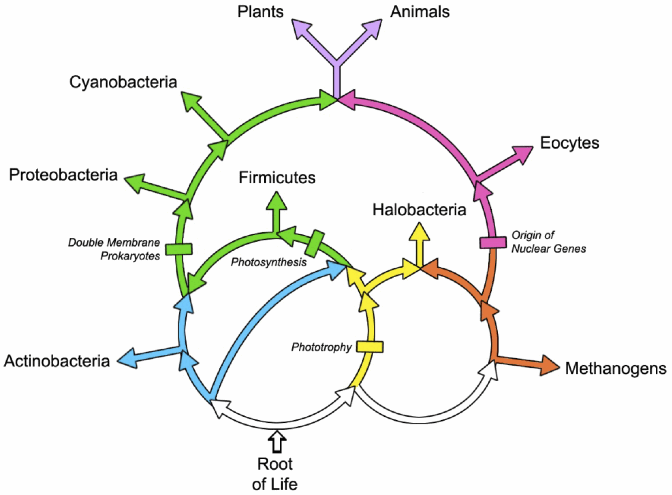
Ten years ago, Rivera and Lake decided to emphasize the series if genome fusions that seem to have been involved in the origin of the major phylogenetic groups by calling it the ring of Life rather than the Tree of Life:
Maria C. Rivera and James A. Lake. 2004. The Ring of Life provides evidence for a genome fusion origin of eukaryotes. Nature 431: 182-185).

This terminology has been repeated in a number of subsequent papers, including:
James McInerney, Davide Pisani and Mary J. O'Connell (2015) The Ring of Life hypothesis for eukaryote origins is supported by multiple kinds of data. Philosophical Transactions of the Royal Society of London B 370: 20140323.
However, life is not that simple, and it has more recently become accepted that a set of inter-connected rings is involved in the metaphor, rather than the simple ring originally presented. Thus we now have the plural Rings of Life, instead.

James A. Lake and Janet S. Sinsheimer (2013) The deep roots of the Rings of Life. Genome Biology and Evolution 5: 2440-2448.
James A. Lake, Joseph Larsen, Brooke Sarna, Rafael R. de la Haba, Yiyi Pu, HyunMin Koo, Jun Zhao and Janet S. Sinsheimer (2016) Rings reconcile genotypic and phenotypic evolution within the Proteobacteria. Genome Biology and Evolution (in press).
I think that the rest of us would still call each of these diagrams a network. Indeed, most of the metaphors that have been used over the years can also be called a network (see Metaphors for evolutionary relationships).

Monday, November 23, 2015

The history of HGT


Because it seems to be an interesting topic, I have written a number of posts about the history of horizontal gene transfer (HGT) in phylogenetics, including:
The first gene transfer (HGT) network (1910)
The first paper on HGT in plants (1971)
HGT networks
The first HGT network
Recently, Nathalie Gontier has produced a comprehensive history of HGT, which makes a major contribution to the field:
N. Gontier (2015) Historical and epistemological perspectives on what horizontal gene transfer mechanisms contribute to our understanding of evolution. In: N. Gontier (ed.) Reticulate Evolution, pp. 121-178. Springer, Switzerland.
In this book chapter, she contemplates why the evidence for HGT was ignored for most of the 20th century:
Many of the mechanisms whereby genes can become transferred laterally have been known from the early twentieth century onward. The temporal discrepancy between the first historical observations of the processes, and the rather recent general acceptance of the documented data, poses an interesting epistemological conundrum: Why have incoming results on HGT been widely neglected by the general evolutionary community and what causes a more favorable reception today? Five reasons are given:
(1) HGT was first observed in the biomedical sciences and these sciences did not endorse an evolutionary epistemic stance because of the ontogeny / phylogeny divide adhered to by the founders of the Modern Synthesis.
(2) Those who did entertain an evolutionary outlook associated research on HGT with a symbiotic epistemic framework.
(3) That HGT occurs across all three domains of life was demonstrated by modern techniques developed in molecular biology, a field that itself awaits full integration into the general evolutionary synthesis.
(4) Molecular phylogenetic studies of prokaryote evolution were originally associated with exobiology and abiogenesis, and both fields developed outside the framework provided by the Modern Synthesis.
(5) Because HGT brings forth a pattern of reticulation, it contrasts the standard idea that evolution occurs solely by natural selection that brings forth a vertical, bifurcating pattern in the “tree” of life.
These are important points, and it is interesting to have so much of the history and epistemology gathered into one place.

Gontier notes:
In prokaryotes, HGT occurs via bacterial transformation, phage-mediated transduction, plasmid transfer via bacterial conjugation, via Gene Transfer Agents (GTAs), or via the movement of transposable elements such as insertion sequences ... In eukaryotes, HGT is mediated by processes such as endosymbiosis, phagocytosis and eating, infectious disease, and hybridization or divergence with gene flow, which facilitates the movement of mobile genetic elements such as transposons and retrotransposons between different organisms.
In this context, knowledge of HGT extends back a long way. Transformation was first observed by Griffith (1928), conjugation was discovered by Lederberg and Tatum (1946), and Freeman (1951) reported on HGT from a bacteriophage. Information about endosymbiosis and phagocytosis extends back even further.

Unfortunately, the history presented is incomplete, because it focuses on microbiology (possibly because the timeline around which the chapter is written "is based upon the timeline provided by the American Society for Microbiology"). The possibility that the asexual transfer of genetic units may be of more general occurrence than just prokaryotes dates back to at least Ravin (1955), who is not mentioned. Thus, for example, the early phylogenetic work of Jones & Sneath (1970) on bacteria is included, but the works of Went (1971) on plants and Benveniste & Todaro (1974) on animals are not referenced. Similarly, the discussion of gene trees versus species trees in bacteria by Hilario and Gogarten (1993) is quoted but not that of Doyle (1992) regarding plants. Thus, there is more history to be written.

The book itself (Reticulate Evolution) is mostly about the broader fields of symbiosis and symbiogenesis, rather than about more specific topics like lateral gene transfer and hybridization.

References

Benveniste RE, Todaro GJ (1974) Evolution of C-type viral genes: inheritance of exogenously acquired viral genes. Nature 252: 456-459.

Doyle JJ (1992) Gene trees and species trees: molecular systematics as one-character taxonomy. Systematic Botany 17: 144-163.

Freeman VJ (1951) Studies on the virulence of bacteriophage-infected strains of Corynebacterium diphtheriae. Journal of Bacteriology 61: 675-688.

Griffith F (1928) The significance of pneumococcal types. Journal of Hygiene 27: 113-159.

Hilario E, Gogarten JP (1993) Horizontal transfer of ATPase genes — the tree of life becomes a net of life. Biosystems 31: 111-119.

Jones D, Sneath PH (1970) Genetic transfer and bacterial taxonomy. Bacteriology Reviews 34: 40-81.

Lederberg J, Tatum EL (1946) Gene recombination in E coli. Nature 158: 558.

Ravin AW (1955) Infection by viruses and genes. American Scientist 43: 468-478.

Went FW (1971) Parallel evolution. Taxon 20: 197-226.