Showing posts with label Buffon. Show all posts

Monday, October 12, 2015

Buffon and the origin of the tree and network metaphors


I have written before about Georges-Louis Leclerc, Comte de Buffon (1707-1788). (Actually, he was called Georges-Louis Leclerc from 1707-1725, and Georges-Louis Leclerc De Buffon from 1725–1773, before becoming a count.) His role in the development of the theory of organic evolution was such that he is worth considering again here, especially given his important role in introducing the tree and network metaphors in phylogenetics.


Buffon

Buffon is usually credited with being in the top triumvirate of influential people in the development of modern biology, along with Aristotle and Darwin. Buffon followed the lead of the physicist Isaac Newton, by trying to explain natural phenomena solely in terms of other observable natural phenomena, rather than resorting to super-natural explanations. (Indeed, Buffon translated one of Newton's books from LAtin to French.)

This was Newton's main contribution to science, his insistence on empirical explanations. He did not invent this idea, but he was the one who effectively created modern science by consistently applying it. Hence the importance of the apple — the explanation for the small-scale phenomenon of a falling apple, which we can see and study experimentally, is the same as for the large-scale orbits of the planets, which we can see but not experiment upon. Consistency of natural explanations, rather than invoking super-natural forces, creates a coherent scientific whole that is amenable to description, explanation and prediction.

Buffon adopted this same scientific approach and applied it to biology. Once again, he did not invent this idea, but he was the one who applied it consistently across all of biology. He did this principally in his Histoire naturelle, générale et particulière, an ambitious work planned to cover all of nature in 50 volumes (it included geology, anthropology and cosmogeny, as well as biology). Begun in 1749, he and a few collaborators completed 36 volumes before his death in 1788, and 8 more were compiled by others shortly afterwards.

In the process of trying to find natural explanations for all empirically observable biological phenomena, Buffon not unexpectedly encountered the idea of mutation of species, as part of his thoughts about an irreversible history of nature. He thus grappled both with species concepts and with temporal change within and between species. He is thus credited as the first modern evolutionist, because he introduced the time element in comparative biology, so that common structure is explained in terms of common ancestry. However, his ideas, published over many decades, were often inconsistent — sometimes he was an evolutionist and sometimes not. This seems to be, at least in part, due to increasing religious pressure — he was an important person in the ancienne regime of France, and not in a position to easily reject the teachings of the Catholic church.

By modern standards, Buffon was wrong on most things (see Buffon's genealogical ideas), as was Aristotle — being first means that you are also the first to get it wrong, to one extent or another. This does not in any way reduce the impressive nature of his work as a pioneer. He was not a cataloguer of information like his great Swedish rival von Linné — he wanted to explain things, not organize them, as he was interested principally in causes. He also moved away from trying to explain biology in terms of physics (eg. the concept of universal essences), and tried to explain it in terms of itself.

Metaphors

Of principal interest for this blog is Buffon's role in the development of metaphors for biological relationships. Given his role as an early adopter of evolutionary ideas, he was also an early adopter of metaphors to depict those ideas about historical relationships.

Buffon argued for temporal continuity rather than eternal types, modification of both natural and domesticated species through time (but only up to a certain point), and an underlying unity of organismal types. The latter idea suggested common ancestry for all animals, but Buffon considered and rejected this hypothesis. Indeed, he also rejected the idea that species descend from each other, thus accepting only within-species evolution. He did, however, have a broad concept of species, based on inter-breeding, so that some of his species correspond to modern taxonomic families.

In a previous blog post (The first phylogenetic network 1755) I noted that Buffon put his thoughts into action when he considered the within-species evolution of dog breeds in volume V his Histoire naturelle. In doing so, he published what is usually considered to be the first avowedly evolutionary diagram. It shows the origin and diversification of dog domestication as known at the time. It includes both temporal and spatial variation among dogs, since Buffon believed that morphological variation was related to different climates, so that climatic differences were the ultimate cause of biological variation.

Although Buffon labeled the diagram as a "Table", in his text he noted that it is [translated] "a table or, if one prefers, a kind of genealogical tree where one may grasp at a glance all the varieties". In modern terms it is actually a hybridization network, since it shows repeatedly that some dog breeds arose as a result of hybridization between other breeds. It is also, of course, a map, since it shows spatial variation, although the geographical content is not strictly respected. The diagram is thus a hybrid of a network and a map.

Note that Buffon used the idea of a tree long before Simon Pallas (1776), who is usually credited with introducing the tree metaphor. However, Buffon was writing solely about within-species relationships, whereas Pallas discussed a much broader scale (specifically, both plants and animals).

Indeed, Buffon's genealogical ideas had first appeared in volume IV of the Histoire naturelle, in 1753 (the same year as Linné's Species Plantarum). In this volume there is a presentation of his ideas on species in "Discours sur la nature des animaux" [Discourse on the nature of animals] and his ideas about animal genealogy in "L'asne" [The ass]. The latter contains this text:
que l'homme et le singe ont eu une origine commune comme le cheval et l'âne; que chaque famille, tant dans les animaux que dans les végétaux, n'a eu qu'une seule souche, et même que tous les animaux sont venus d'un seul animal qui, dans la succession des temps, a produit, en se perfectionnant et en dégénérant, toutes les races des autres animaux. [that man and ape have had a common origin like the horse and the donkey; every family, both in animals and in plants, had only a single stem [stock], and even all the animals came from a single animal which, in the succession of time has produced by perfection and degeneration, all the races of the other animals.]
Buffon was, however, not consistent in his uses of metaphors. This topic is discussed in detail by Giulio Barsanti (1992), and he has provided a convenient chart of Buffon's metaphors — the following version is taken from Ruse and Travis (2009).


Note that Buffon used the traditional chain analogy most often, since this can be used for ancestor–descendant relationships. However, he simultaneously used the tree and map in 1755 (as discussed above), and he effectively replaced the tree with the map after 1780. The map had previously been introduced by von Linné in 1751 ("All plants show affinities on either side, like territories in a geographical map").

It is interesting to see the rapid rise and fall of the family-tree metaphor in the mid 1700s, before its resurgence a century later. The cluster of tree references in 1766 is from "De la dégénération", in volume XIV of Histoire naturelle. "Dégénération" was Buffon's term for evolution.

References

Barsanti G (1992) Buffon et l'image de la nature: de l'échelle des êtres à la carte géographique et à l'arbre généalogique [Buffon and the image of nature: the scale of being to the map and to the family tree]. In: Gayon J (ed.) Buffon 88: Actes du Colloque International [pour le bicentenaire de la morte de Buffon] (Paris-Montbard-Dijon, 14-22 juin 1988), pp. 255-296. Paris: Librairie Philosophique J. Vrin.

Ruse M, Travis J (2009) Evolution: The First Four Billion Years. Belknap Press, Cambridge MA, p 458.

Wednesday, March 7, 2012

Why do we still use trees for the dog genealogy?


In my previous two posts on Georges-Louis Leclerc, comte de Buffon, and his original dog genealogy of 1755, and the model for it, my interest was in Buffon's pioneering spirit in developing new ideas about genealogies and their presentation. However, it also seems natural to wonder how much we have progressed in the 250 years since then.

Having looked at the recent literature, there currently seem to be three distinct trends within dog phylogenetics:
  1. the study of whole-genome data, in which the results are presented solely as a neighbor-joining tree
      Parker et al. (2004)
      von Holdt et al. (2010)
  2. the study of mtDNA sequence data, in which the results are presented both as a tree and as a haplotype network
      Brown et al. (2011)
      Kropatsch et al. (2011)
      Oskarsson et al. (2012)
      Ryabinina (2006)
  3. the study of combined Y-chromosome and mtDNA sequence data, in which the results are presented solely as a haplotype network
      Leonard et al. (2002)
      Li et al. (2011)
      Pires et al. (2006)
      Savolainen et al. (2002)
      Savolainen et al. (2004)
      Sundqvist et al. (2006)
      Verginelli et al. (2005)
It is difficult to look at this list and not feel that there is a great deal of historical inertia here, regarding the choice of analysis method. People like Hans Bandelt have developed network methods explicitly for mtDNA data, such as median-joining and reduced-median networks; and the literature is replete with papers using these methods to analyze mtDNA sequences, especially the so-called "mitochondrial control region". On the other hand, these methods seem to be less commonly employed for other data types, where instead trees are de rigeur. So, people are apparently choosing their analyses based on historical convention within their field, rather than their suitability for the purposes at hand. Perhaps the papers where both methods are used should be seen as a compromise? Or should I be optimistic and see tham as part of a move away from trees towards the use of networks?

I have shown the two dog trees here. Both of them make it abundantly clear, even to the casual observer, that a tree is inappropriate for the data at hand.

Dog phylogeny (Parker et al. 2004) [Click to view]

The tree from Parker et al. has extremely small bootstrap values for almost all of the branches (only those >50% are shown on the tree), and even the group of modern dog breeds does not get up to 50% support. Clearly, there is massive conflict in this dataset. [Do not ask me why there is a value of 100% for the single branch at the base of the tree, since its presence is illogical.]

Dog phylogeny (von Holdt et al. 2010)

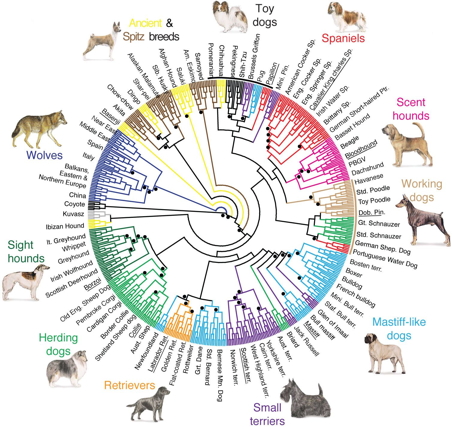
The tree from von Holdt et al. has broader coverage but is even more clearly non-tree-like. The dots indicate the branches with >95% bootstrap support and the colours indicate the 10 groups of dog breeds recognized by the Fédération Cynologique Internationale. As you can see, many of the breeds are scattered around the genetic tree, indicating cross-breeding in the genealogical history. This paper thus follows Buffon by nominating representative breed groups but fails by not showing the cross-breeding. So, it is drawn as a tree not a network, even when we know the history is not a tree. The use of colouring in the phylogenetic tree is one interesting way to indicate cross-connections in the genealogy, but cross-connecting lines is more explicit. [Interestingly, later editions of Buffon's work sometimes used hand-colouring of the genealogy to emphasize the breed groups that Buffon discusses in his text, so even this is not original.]

In both of these cases the tree analysis seems wildly inappropriate. As Buffon wisely told us 250 years ago, domestic dog breeds do not have a simple tree-like ancestry. It almost seems insulting that 2.5 centuries later we are still trying to fit these very same breeds (plus their numerous more-recent descendant breeds) into the straightjacket of a tree. We need to learn from the past if we are to progress into the future.

By the way, the patterns discussed here for phylogenetic analysis seem to be true for all groups of domesticated organisms. [You could try searching for the horse genealogy on the web, and you will see what I mean.] I am thus using the dogs merely as one convenient example. Following Andersen (1990), I do not intend "to pillory the few for errors which many commit with impunity".

Added note:
Since writing this post, another paper has appeared that can be added to group 1 (whole-genome data, with the results presented solely as a neighbor-joining tree): Larson et al. (2012).

References

Andersen B. (1990) Methodological Errors in Medical Research: an Incomplete Catalogue. Blackwell Science, Oxford.

Brown S.K. et al. (2011) Phylogenetic distinctiveness of Middle Eastern and Southeast Asian village dog Y chromosomes illuminates dog origins. PLoS One 6(12): e28496.

Kropatsch R. et al. (2011) On ancestors of dog breeds with focus on Weimaraner hunting dogs. Journal of Animal Breeding and Genetics 128: 64–72.

Larson G et al. (2012) Rethinking dog domestication by integrating genetics, archeology, and biogeography. Proc Natl Acad Sci USA 109: 8878-8883.

Leonard J.A. et al. (2002) Ancient DNA evidence for Old World origin of New World dogs. Science 298: 1613–1616.

Li Y. et al. (2011) The origin of the Tibetan Mastiff and species identification of Canis based on mitochondrial cytochrome c oxidase subunit I (COI) gene and COI barcoding. Animal 5: 1868-1873.

Oskarsson M.C.R. et al. (2012) Mitochondrial DNA data indicate an introduction through mainland Southeast Asia for Australian dingoes and Polynesian domestic dogs. Proceedings of the Royal Society B 279: 967-974.
Parker G. et al. (2004) Genetic structure of the purebred domestic dog. Science 304: 1160-1164.

Pires A.L. et al. (2006) Mitochondrial DNA sequence variation in Portuguese native dog breeds: diversity and phylogenetic affinities. Journal of Heredity 97: 318-330.

Ryabinina O.M. (2006) Genetic diversity and phylogenetic relationships in groups of Asian Guardian, Siberian Hunting and European Shepherd dog breeds. Proceedings of the Fifth International Conference on Bioinformatics of Genome Regulation and Structure, Volume 3, 50.

Savolainen P. et al. (2002) Genetic evidence for an East Asian origin of domestic dogs. Science 298: 1610–1613.

Savolainen P. et al. (2004) A detailed picture of the origin of the Australian dingo, obtained from the study of mitochondrial DNA. Proc Natl Acad Sci USA 101: 12387-12390.

Sundqvist A.-K. et al. (2006) Unequal contribution of sexes in the origin of dog breeds. Genetics 172: 1121–1128.

Verginelli F. et al. (2005) Mitochondrial DNA from prehistoric canids highlights relationships between dogs and south-east European wolves. Molecular Biology & Evolution 22: 2541-2551.

von Holdt B.M. et al. (2010) Genome-wide SNP and haplotype analyses reveal a rich history underlying dog domestication. Nature 464: 898-902.

Thursday, March 1, 2012

Buffon's genealogical ideas

Following on from my earlier post about the network genealogy of dogs by Georges-Louis Leclerc, comte de Buffon (1707-1788), it seems appropriate to mention some other notable aspects of his treatment of the dog genealogy.

Buffon is usually considered to have been a remarkable man, whose influence on modern evolutionary science has been profound: "Except for Aristotle and Darwin, there has been no other student of organisms who has had as far-reaching an influence" (Ernst Mayr. 1982. The Growth of Biological Thought: Diversity, Evolution, and Inheritance). He was greatly influenced by Isaac Newton, who sought to describe the workings of nature as being under the control of natural forces. Buffon successfully applied this idea to biology and geology, so that "after Buffon it became impossible for naturalists to refer uncritically to non-natural explanations for natural phenomena" (Keith R. Benson. 2004. Encyclopedia of the Early Modern World).


Buffon's multi-volume Histoire naturelle générale et particulière was intended to describe all of nature rather than merely to catalogue it, as was being done so successfully by his contemporary Carl von Linné (1707-1778). He started with geology in the first few volumes of the Histoire, and then proceeded on to domesticated animals. The coverage of dogs was preceded in the same volume (V) by sheep, goats and pigs; with horses, asses, cows and bulls being in the previous volume (IV), and cats in the subsequent volume (VI).

Dogs were domesticated from the Gray Wolf at least 10,000 years ago, and dogs similar to some modern breeds appeared at least 4,000 years ago. Genetic analyses indicate that most modern breeds have arisen probably <200 years ago (and almost certainly <400). So, Buffon had less material to work with (and explain) than we do, especially given his lack of knowledge about the numerous types of "village dogs" in Africa and Asia.

Buffon's Ideas

Buffon recognized 30 “fixed varieties” and 17 “variable races”, grouped into four main functional / geographic classes. The Fédération Cynologique Internationale (World Canine Organization) currently recognizes ~350 breeds of dog, classified into 10 groups according to their domesticated function and, to a lesser degree, area of origin; so Buffon's basic approach to the subject continues today.

Moreover, Buffon nominated what may be called "progenitor breeds" for each class, with the remaining breeds within each class being derived from that progenitor. This matches our current understanding of domestication, with ~10 progenitor breeds being originally developed to fulfill different roles required by humans (e.g. herding, retrieving, hunting), and then today's pure breeds being derived from those progenitors during the subsequent few millenia. So, our current understanding of the origin of dog genetic variation is essentially the same as that adopted by Buffon. He was, in this sense, an influential pioneer.

Buffon's use of a network to visualize his ideas on genealogy seems to be entirely original. Interestingly, his use of solid lines in the network to represent the underlying tree of vertical descent (parent to offspring) and dashed lines to represent the horizontal genealogy of cross-breeding (hybridization) is the precursor to much modern practice. Most of the contemporaneous networks, which represented similarity relationships rather than historical ones, treated all linkages as equal.

Buffon did, by modern reckoning, get the details of the network root wrong. He nominated the "Shepherd Dog" as the root, and also as being part of a group with the Icelandic Sheepdog, Lapland Dog and Siberian Husky. We do not now include sheepdogs in that group, but these other dogs are today considered to be part of the sister group to all other modern breeds. So, Buffon's idea was along the right track.

Furthermore, Buffon expected the wolf to be the natural ancestor of modern dogs, which accords with modern genetic data showing wolves to be the sister group to all dogs. However, Buffon, failed in his experimental attempts to cross-breed dogs and wolves (he would never have gotten his described experiments past an ethics committee!), and also dogs with foxes. So, he concluded that the "dog derives not his origins from the wolf or fox." Nevertheless, he still maintained that "Each one of these species is truly so close to the others" and the "individuals resemble each other so much . . . that one has difficulty conceiving why these animals cannot reproduce together." This persistence was soon vindicated, when a "Mr Brook, animal-merchant of Holborn" did succeed in cross-breeding a female dog and a male wolf [as reported in William Smellie's English translation of Buffon's work].

Buffon did, however, have one major stumbling block. He believed in the fixity of species, and so the diversity of modern domestic breeds required careful thought on his part. He had no problem with the idea that a mule is the sterile offspring of a donkey and a horse, but the fertile inter-breeding of a wide morphological variety of domestic dog breeds put a great strain on the idea of fixed species. He thus settled on a theory of transmutation of domesticated animals in response to environmental effects. For example, when one dog breed is transported to a different climate it changes into a different type of dog. [It's unclear if he thought that the actual animal changed, or if it's offspring were born in this new form.] This idea was taken up by Buffon's intellectual successor Jean-Baptiste Pierre Antoine de Monet, Chevalier de Lamarck (1744-1829), who applied a much broader version of the same idea to natural species as well as to domesticated ones.

It is worth noting that Buffon's transmutation idea was not actually crazy. He was simply being a consistent Newtonian by attributing a common cause to diverse phenomena. Since it was known that different geographical areas have different floral and faunal assemblages, Buffon attributed to the same environmental factors variation due to both geography and domestication. Indeed, by relating biodiversity to environment Buffon has actually been seen as the father of modern biogeography (Mayr 1982).

Conclusion

So, it seems top me that Buffon did remarkably well when presenting his ideas about the dog genealogy. He pioneered some things, got others basically right but missed in the details, and really got only one idea fundamentally wrong. His idea of a transformable "moule intérieur" was the best he could come up with in the absence of any idea about genetics, but surely he would have understood modern genetics very well if he had lived to see it.

Sunday, February 26, 2012

The first phylogenetic network (1755)


Recently, I was asked by Jesper Jansson "where exactly did the first published phylogenetic network appear?" Obviously, the answer to this question can depend on precisely how one defines "phylogenetic", especially as our current understanding of the word did not arise until the late 1800s, notably with the works of St George Jackson Mivart and Ernst Heinrich Haeckel (who actually coined the word "phylogeny"). Nevertheless, if we treat the concept broadly as requiring only an explicit reference to a genealogy, then it seems possible to nominate a candidate.

Mark Ragan suggested to me that, based on his own research as presented in his Biology Direct paper, the most likely candidate is the genealogical network of races of dogs ("Table de L'Ordre des Chiens") produced by Georges-Louis Leclerc, comte de Buffon (1707-1788). I have followed up this lead, and I agree with Mark that it is "not only a network but an explicitly genealogical one". Thus, it seems to me that this publication certainly qualifies as a phylogenetic network. Indeed, even Charles Darwin (from the 4th edition of the Origin, 1866, onwards) acknowledged Buffon as "the first author who in modern times has treated it [evolution] in a scientific spirit".

Buffon's magnum opus was the 36 volumes of the Histoire naturelle générale et particulière (Imprimerie Royale, Paris). The publishing history of this work is a mess, with dozens of French editions and numerous translations, and both official and bootleg printings. Indeed, this was undoubtedly the most popular work on natural history in the late 18th and early 19th centuries. The most readily available printed version today is the one edited by Jean Piveteau in 1954, although various editions are now available online. So, it is important to consult the first edition to arrive at a suitable date.

The illustration shown here is a foldout located between pages 228 and 229 of Volume 5, published in 1755 (Volume 1 had appeared in 1749). A larger GIF version [434 KB] is available for download from my homepage and a PDF version [2.6 MB] is on the RJR Productions webpage. The image is taken from the online (scanned) version of the first edition, located at: http://www.buffon.cnrs.fr/. [It is perhaps worth noting that the first edition of this volume of the Histoire was co-authored by Louis-Jean-Marie Daubenton; but the dog genealogy is clearly Buffon's work alone.]


The Network

On p. 225 of the Histoire, Buffon writes: "Pour donner une idée plus nette de l’ordre des chiens, de leur dégénération dans les différens climats, et du mélange de leurs races, je joins ici une table, ou, si l’on veut, une espèce d’arbre généalogique, où l’on pourra voir d’un coup d’œil toutes ces variétés : cette table est orientée comme les cartes géographiques, et l’on a suivi, autant qu’il étoit possible, la position respective des climats. Le Chien de Berger est la souche de l’arbre : ....." [The 1781 English translation by William Smellie is: "To give a clear idea of the different kinds of dogs, of their degeneration in particular climates, and of the mixture of their races, I have subjoined a table, or genealogical tree, in which all these varieties may be easily distinguished. This tree is drawn in the form of a geographical chart, preserving as much as possible the position of the different climates to which each variety naturally belongs. The shepherd’s dog is the root of the tree ....."]

This text is then followed by a description of the main lines of historical relationship among the dog breeds. Then, on p. 227 Buffon further notes: "Toutes ces races, avec leurs variétés, n’ont été produites que par l’influence du climat, jointe à la douceur de l’abri, à l’effet de la nourriture, et au résultat d’une éducation soignée ; les autres chiens ne sont pas de races pures, et proviennent du mélange de ces premières races : j’ai marqué par des lignes ponctuées, la double origine de ces races métives." [Smellie's translation: "All these races, with their varieties, have been produced by the influence of climate, joined to the effects of shelter, food, and education. The other dogs are not pure races, but have proceeded from commixtures of those already described. I have marked, in the table, by dotted lines, the double origin of these mongrels."]

Buffon's own interpretation of this diagram as a hybridization network thus seems clear enough. If anyone can locate an earlier diagram that can be interpreted as a phylogenetic network, then please let me know.

Update: This later post has more information about Buffon and this network.